A casa terrera is renovated from the top down: first the flat roof and the façade, then the wiring and plumbing, and the finishes last. Before asking for a price you need to know where the damp is coming from, what condition the waterproofing is in and which permit applies to you, which depends on whether you touch the structure, the layout or the façade. As a guide, a full renovation of a detached house in Tenerife ranges from €500–€1,500/m², with most works between €700 and €1,000/m², and takes three to five months on site plus however long the town hall takes.
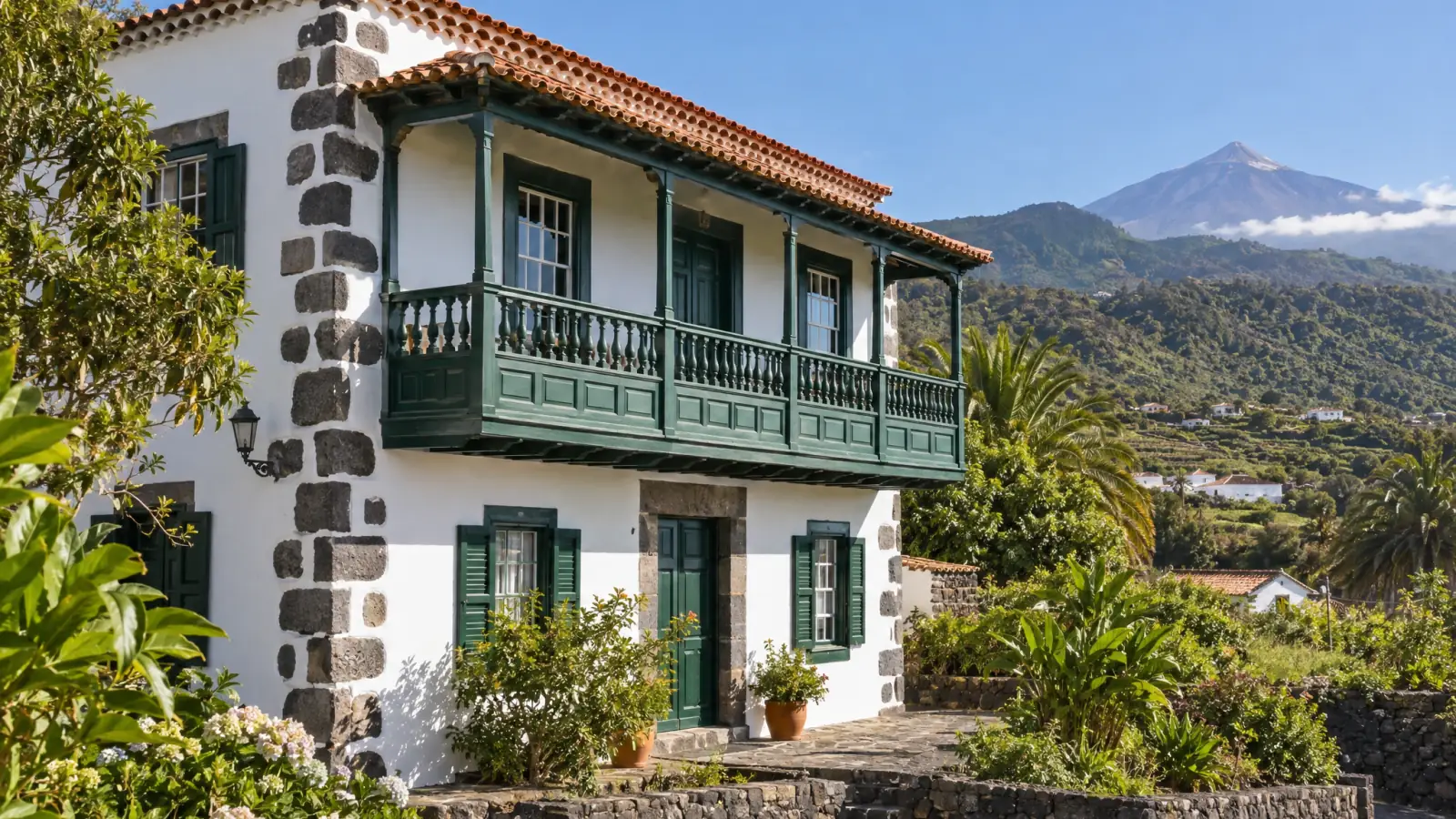
The casa terrera is the traditional single-storey house, sometimes two storeys, at street level, with a walkable flat roof or a tiled roof, found in the villages of the midlands (medianías) and in the old town centres all over the island. It has one thing going for it: there is no community of owners (comunidad de propietarios) to ask for permission to touch common elements. But it isn’t renovated like a flat, because the roof, the façade and the drainage are yours, and so are their problems. This guide goes over what to look at and in what order.
The order: from the top down
The most expensive mistake in a house is starting on the inside. If the flat roof leaks, the water ends up in the new paintwork, in the false ceiling or behind the newly tiled kitchen walls. The order that pays off is this:
- Watertightness: flat roof or roof, parapets, roof drains and façade. Keep the water out.
- Wiring and plumbing: electrics, plumbing and drainage. They mean cutting channels all over the house, so they come before the wall and floor coverings.
- Layout and windows and doors: if you’re going to move partition walls or change windows, this is where it’s decided, and it’s what most affects the permit.
- Finishes: floors, wall tiling, paintwork, kitchen and bathroom.
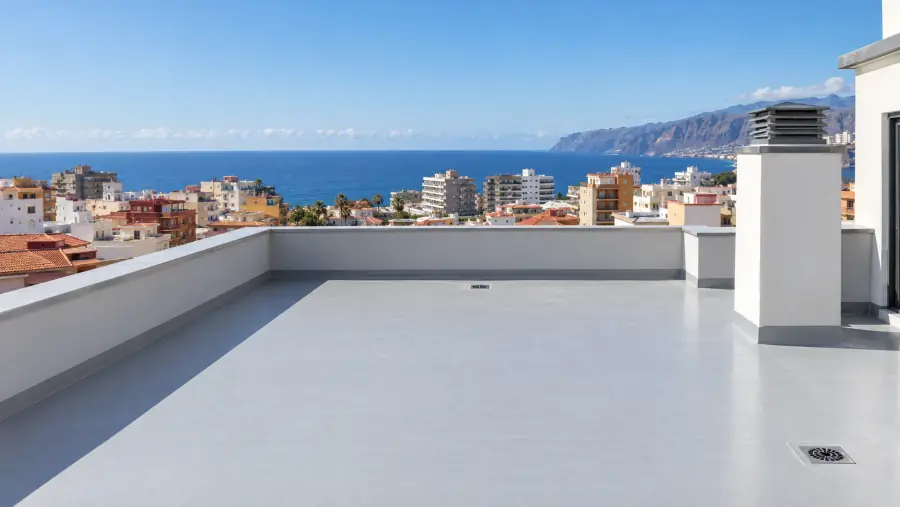
The flat roof: repair or redo
Most leaks don’t come in where the stain appears: the water runs across the top of the slab until it finds a joint or a service penetration to get down through. That’s why the first step is to go up, find the real source and decide whether a localised repair is enough or the whole waterproofing has to be redone. These signs mean it’s worth having it checked before it starts dripping:
- Stains or white efflorescence on the ceiling, even if it isn’t dripping.
- Standing water on the flat roof 24 hours after rain: a fault in the fall or the roof drain.
- Cracks or the membrane coming away where it meets the parapets.
- Plants growing in joints or around the outlets.
- Blistered paint on the façade just below the edge of the roof.
A localised repair to a junction or a roof drain is done in two or three days; redoing the waterproofing of a detached house’s flat roof, in one or two weeks. The weather is what matters most: you can’t waterproof onto a damp base, so in the north you have to wait for a dry spell. We explain it in detail in roof waterproofing and in our guide to flat roof leaks.
Damp in walls and ceilings
In a casa terrera the damp can come from several places, and each one is treated differently. Painting over it hides it for a few months and then it comes back:
- Through the roof. This is the most common, and the first one to rule out.
- From condensation. In the midlands of the north, humidity is high for much of the year, roofs barely get the chance to dry out between spells of rain, and in poorly ventilated homes condensation indoors is a real problem.
- In old walls. Traditional Canary Islands houses have very thick walls, and they don’t take standard solutions: modern mortars, which barely breathe, can make the damp in a historic wall worse instead of solving it.
- On the coast, salt air. It isn’t damp, but it eats away at fittings, railings, fixings and windows and doors, and calls for materials that wouldn’t be needed in the midlands.
If the house has a timber structure or timber windows and doors, they’re checked on the visit: they need treating and sometimes replacing with equivalent elements.
Wiring, plumbing and drainage
Many old houses have two circuits for the whole home, no real earth and iron or lead pipes. An electrical installation from the 1970s can’t be patched up: it has to be redone completely. Electrics and plumbing are quoted together because they’re carried out together, and renewing both in a medium-sized home usually costs between €3,000 and €7,000, including the electrical installation certificate (boletín).
In a house, the drainage is also yours as far as the connection to the mains sewer, and it’s worth checking it while the works are open. If you’re going to increase the power supply or are thinking about solar panels or an air-source heat pump, this is the moment to leave the installation ready for it. More detail in electrics and plumbing in renovations.
Which permit you need
It depends on what you change, not on the size of the house. As a guide, according to the guide to building permits in Tenerife:
| What you want to do | Usual procedure | Architect’s project? |
|---|---|---|
| Paint and change floors | Prior notification (comunicación previa) | No |
| Renew plumbing and electrics | Minor works (obra menor) | No (but an electrical certificate, yes) |
| Full renovation without changing the layout | Minor works | Usually not |
| Knock down partition walls or join rooms | Major works (obra mayor) | Yes |
| Make an opening in a load-bearing wall | Major works | Yes, with structural calculations |
| Change windows in a way that alters the façade | Major works | Yes |
Two warnings specific to the casa terrera. If it’s in a historic centre – La Orotava, La Laguna, Icod de los Vinos or Garachico, for example – almost any work that can be seen from the street requires an additional report and stricter criteria. And if the house has old extensions built without a permit, legalising them is a planning matter separate from the renovation. The main cost of the permit is the ICIO (municipal construction tax), around 3–4% of the construction budget, plus the municipal fee. If you don’t know which applies to you, the building permit assistant tells you in five questions.
The criteria and fees depend on each town hall’s by-laws. The exact procedure is always confirmed with your municipality before you start. This is not legal advice.
How much it costs and how long it takes
A full renovation of a detached house in Tenerife usually costs €500–€1,500/m², with most works in the €700–€1,000/m² range. The range is wide because it covers very different things: renewing finishes is at the bottom, and stripping the house back to the brick, redoing the wiring and plumbing, working on the roof and changing the windows and doors is at the top. What moves the figure most in a house:
- The condition of the roof.
- How close it is to the sea, and the salt air.
- Access: a house a lorry can’t reach makes every delivery and every removal of rubble more expensive.
- The age of the wiring and plumbing.
- The standard of finish.
The works usually take between three and five months from the moment the first trade arrives, plus however long the municipal paperwork takes. Prices exclude taxes: in the Canary Islands IGIC applies, not VAT. You’ll find the details in house and villa renovation, and if you’d like a range for your case, in the price calculator.
What can turn up when things are opened up
In an old house it’s normal for something to turn up: a beam in poor condition, a broken downpipe inside the wall, damp behind the wall tiles. When it happens, we pause that line item, show it to you in photos, give you priced options and you decide. A written addendum is drawn up, and nothing you haven’t approved is carried out or invoiced. If the diagnosis shows that the roof problem isn’t one of watertightness but of the slab itself, the structural reinforcement is a separate line item.
If you’d like us to look at your house, tell us what you need when you ask for your quote. The visit is free: we go up onto the flat roof, look at the wiring, plumbing and damp, and tell you which procedure applies to you before putting a figure on it.
Frequently asked questions
Where do I start when renovating a casa terrera?
At the top: the flat roof and the façade. Before touching floors, paintwork or the kitchen, you have to make the house watertight, because renovating an interior under a roof that leaks is throwing money away. Next come the wiring and plumbing, which mean cutting channels into the walls, and the finishes go last.
How much does it cost to renovate a casa terrera in Tenerife?
A full renovation of a detached house ranges from €500 to €1,500 per square metre, and most projects fall between €700 and €1,000/m². A house has line items that a flat doesn’t: the roof, the façade on every side and its own drainage. Prices exclude IGIC (the Canary Islands’ indirect tax, instead of VAT) and are subject to a site visit.
How much does it cost to waterproof the flat roof?
We don’t give a price without seeing it, because it depends on the condition of the base: if the existing waterproofing is sound, the new layer can go on top; if it has reached the end of its life or there is damp trapped underneath, it has to be stripped off, and that doubles or triples the line item. The site visit and the diagnosis are free.
Can I live in the house while it’s being renovated?
In a full renovation it’s very difficult and we don’t recommend it: there are days with no water, no electricity and dust everywhere. If the house has two floors, it’s sometimes possible to work in phases and keep one of them habitable, although the works take longer.
What if the house has an old extension built without a permit?
Legalising earlier works is a planning matter separate from the renovation, and it isn’t included in our quote. It’s worth knowing before you start, because it determines what can be applied for on that part of the house.