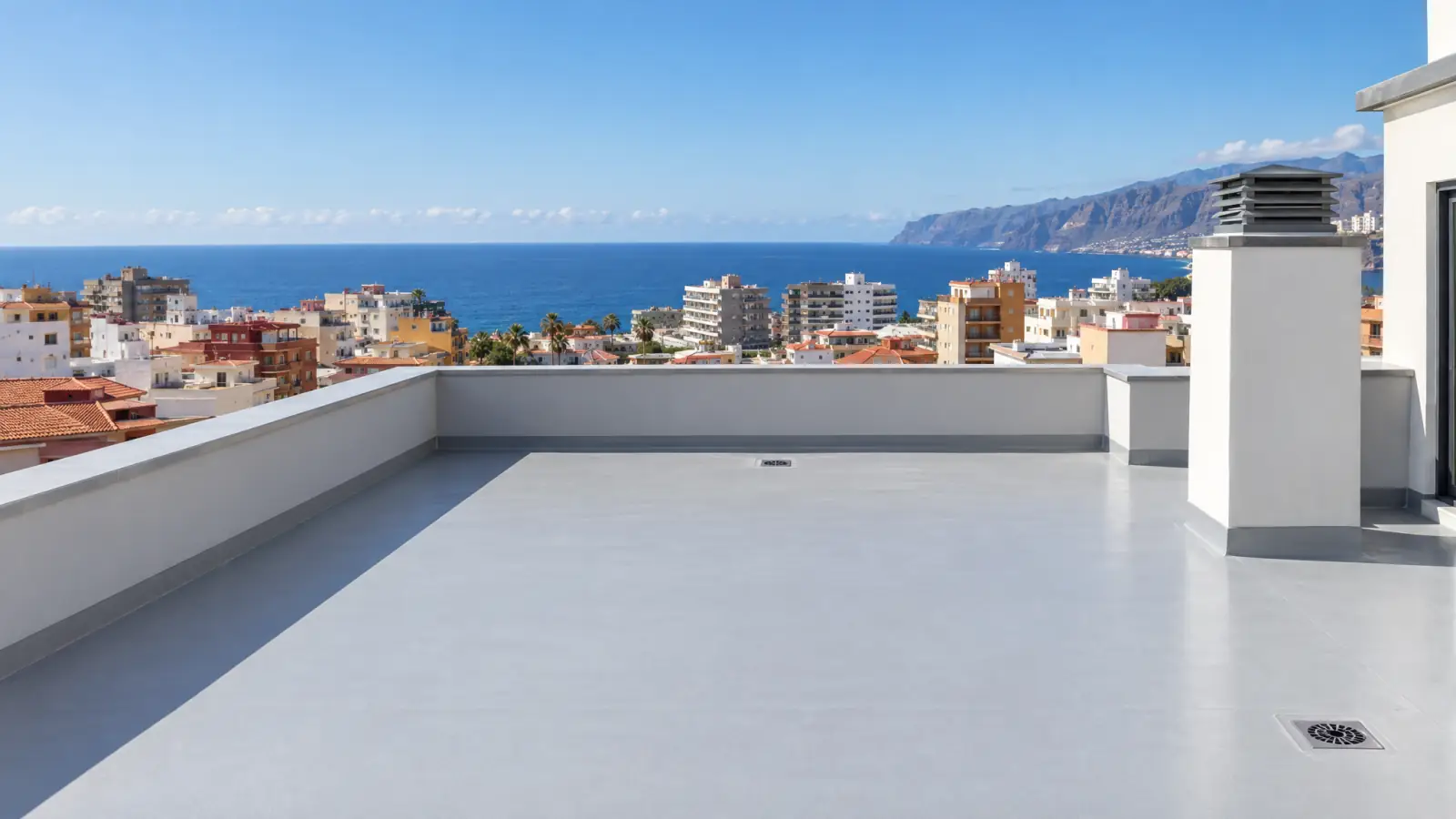
A localised repair is enough when the water gets in at one specific point (a junction with the parapet, a roof drain, a service penetration) and the rest of the waterproofing is sound. The whole thing has to be redone when the membrane has reached the end of its life, there’s damp trapped underneath, water sits on the roof because the fall is inadequate, or leaks appear in several places. To know which applies to you, someone has to go up and find the real source, which is almost never directly above the stain. A localised repair takes two or three days; redoing the flat roof of a house, one or two weeks.
A leaking flat roof is one of those problems that drags on: it appears with the first heavy rain, dries out, gets forgotten and comes back the following year a little bigger. In Tenerife it doesn’t rain much, but when it does it comes all at once, so tired waterproofing can go months without showing any sign and then fail suddenly in a single downpour. This guide helps you understand what’s going on before you ask for a quote.
Why the stain is misleading
Water doesn’t travel straight down. It gets in at the roof’s weak point, runs across the top of the slab until it finds a joint or a service penetration to get down through, and sometimes shows up on the ceiling several metres away. That’s why patching directly above the stain fails so often.
A proper diagnosis starts on the roof and focuses on the critical details, which is where most waterproofing fails:
- The junctions with the parapets and the perimeter finishes.
- The roof drains and downpipes, and whether the water reaches them or stops short.
- Chimneys, aerial bases and service penetrations.
- The supports for air-conditioning units or panels that were fixed by drilling through the waterproofing.
- The falls: whether there are areas where water is still standing a day after rain.
When a repair is enough
A localised repair makes sense when the fault is confined to one spot and the rest of the roof is in good condition:
- There’s a single area with a leak, and the point where the water gets in can be identified.
- The membrane on the rest of the roof is well bonded and free of cracks.
- The water drains away properly and doesn’t pool.
- There’s no damp trapped under the flat roof’s surface.
The area is cleaned back, the junction or roof drain is reinforced with the right system, and the job is done in two or three days. If someone suggests redoing the whole roof in a case like this, ask them to explain why.
When the whole roof has to be redone
These signs mean the waterproofing has reached the end of its life:
- Stains or white efflorescence on the top-floor ceiling in several places, even if it isn’t dripping.
- Standing water 24 hours after rain: a fault in the fall or the roof drain.
- Cracks or the membrane coming away where it meets the parapets.
- Plants growing in joints or around the outlets.
- Blistered paint on the façade just below the edge of the roof.
The key question here is whether the new system can go on top or the old one has to come off. If the existing waterproofing only has hairline cracks, the new system can be applied over it. If it has reached the end of its life or there’s damp trapped underneath, it has to be stripped off and the base repaired, and that doubles or triples the line item. On a detached house the whole job takes one or two weeks.
If the flat roof is also a roof terrace you walk on and the floor is going to be replaced, the order is always the same: waterproofing, falls and roof drains, and only then the floor. Laying a new floor over worn-out waterproofing is the most common reason the stain comes back; we explain it in terrace and sun terrace renovation.
What the island does to a flat roof
In the south, the sun is intense almost all year round and the daily expansion and contraction wear the material out until it opens up at the junctions. In the north, the humidity is persistent and the roof barely gets a chance to dry out between spells of rain, which speeds up deterioration and lets plants grow in the roof drains. And all along the coast, salt air attacks metal fixings and edge finishes.
That has a practical consequence for timing: in the south you can waterproof practically all year round; in the north you have to wait for a dry spell, because working on a damp base is the most common reason new waterproofing fails the following year.
What to do in the meantime
General advice for the days between the leak appearing and it being repaired:
- Clear the roof drains and remove leaves or plants from the flat roof, if you can get up there safely. A blocked outlet turns any rain into a puddle that eventually finds its way in.
- Take dated photos of the stain and how it changes after each rainfall. They help locate the source and will be useful if you make an insurance claim.
- If you have home insurance and there’s damage inside, report it. What’s covered depends on your policy.
- Don’t paint the ceiling yet. Damaged paint, plaster or false ceilings are repaired once the roof is sorted and the ceiling is dry; before that, the stain comes back.
If the flat roof belongs to the building
If you live on the top floor and the leak comes from the building’s roof, the flat roof is a common element: the decision and the hiring belong to the community of owners (comunidad de propietarios), even if you’re the only one with the problem. The useful thing is to notify the property manager or the president in writing and take a report and an itemised quote to the owners’ meeting, so that the vote is based on real information. We prepare it; you can see how in renovations for communities of owners.
A very common case on the island is the roof for private use: the terrace that only you use but which is, at the same time, the ceiling of the neighbour below. Normally upkeep of the common element falls to the community and maintenance arising from its use falls to the owner, but it depends on the specific bylaws, so it’s worth clarifying in writing before work starts.
If your house is detached, the flat roof is yours and so is the decision: we explain it in the guide to renovating a casa terrera, where the roof always comes first.
What the quote should include
We don’t publish a price per square metre for waterproofing, and we recommend being wary of anyone who gives one without going up: until the base can be seen, any figure is a guess that goes up as soon as things are opened up. What you can insist on is that the quote states the following in writing:
- The diagnosis: where the water is getting in, and whether the new system goes on top or the old one comes off.
- Preparation of the base: removal of deteriorated material, cleaning and repair of cracks.
- The specific system: liquid polyurethane membrane, bitumen sheet or a system with reinforcing mesh, not just “waterproofing”.
- The critical details one by one: parapets, roof drains, chimneys, service penetrations.
- Falls and roof drains: inspection, cleaning and correction if water pools.
- The area measured including the parapets, whose vertical faces add more square metres than it looks from below.
- The finish: walkable or reflective paint, depending on how the flat roof is used.
- A watertightness test before the job is signed off, especially if a floor is going on top afterwards.
- The written guarantee from the system’s manufacturer, and what it covers.
- What’s excluded: interior damage (paint, plaster, false ceilings) is quoted separately, once it has dried out.
If you’d like us to take a look, ask for your quote: we go up onto the roof, find the source and tell you clearly whether yours needs a localised repair or redoing. All the details of the service are in roof and flat roof waterproofing in Tenerife.
Frequently asked questions
How much does it cost to fix a leak in a flat roof?
It depends on whether it’s a one-off fault or the waterproofing has reached the end of its life, and the only way to know is to go up and look. That’s why we don’t give prices over the phone: if the membrane is sound, the new work goes on top and the job stays contained; if it has to be stripped off and the base repaired, the line item doubles or triples. The site visit and the diagnosis are free, and they lead to an itemised fixed-price quote.
How long does it take?
A localised repair to a junction or a roof drain, two or three days. Redoing the waterproofing on the flat roof of a detached house, one or two weeks, and on a communal roof of some size, about three. The weather is what matters most: you can’t waterproof onto a damp base.
Does sealing the crack with silicone or giving it a coat of paint work?
As an emergency patch it may hold the water back for a few days, but it doesn’t solve anything: the point where the water really gets in is hardly ever the one that gets sealed, and paint over damp only hides it for a few months. What’s more, anything applied on top without preparation can make a proper waterproofing job harder later on.
I live on the top floor and the leak comes from the building’s flat roof. Who fixes it?
If the flat roof is a common element, the decision and the cost belong to the community of owners, even if you’re the only one suffering the damage. Notify the property manager or the president in writing. If it’s a roof for private use, it depends on the community’s bylaws, and it’s worth clarifying in writing before work starts. We can prepare the report and the quote for you to take to the owners’ meeting.
What guarantee should waterproofing come with?
Whatever the manufacturer of the system applied gives in writing, plus the legal guarantee on the works. Both should appear in the quote, with what they cover. Be wary of a long guarantee promised verbally without saying which system it applies to.